Lawyer
Jim Mattox
Texas
Jim Mattox has appeared in 167 court cases in our database. View their complete case history and outcome statistics below.
About
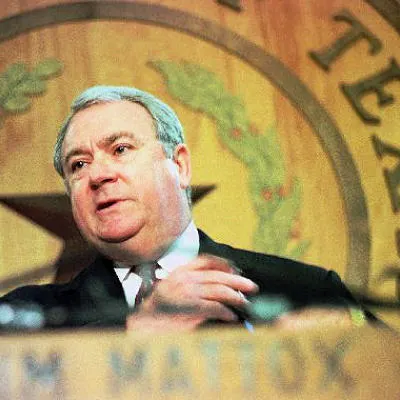
Jim Mattox served as the forty-seventh attorney general of the state of Texas from 1983 to 1991. Image available on the Internet and included in accordance with Title 17 U. S. C. Section 107. Mattox, James Albon [Jim] (1943-2008). James Albon Mattox, attorney general of Texas, was born in Dallas, Texas, on August 29, 1943. He was the son of Norman Stephen Mattox, a sheet metal worker, and Mary Kathryn (Harrison) Mattox, a waitress. When he was a child, his parents frequently fought, which led young Mattox and his younger brother Jerry and sister Janice to spend much of their time with their grandmother in South Dallas. While working as a busboy and cook at a local restaurant and hotel, he attended Woodrow Wilson High School in Dallas. Mattox graduated from high school in the bottom half of his class in 1961. A school counselor discouraged him from seeking a college education, so Mattox sold Bibles door-to-door after graduation. His high sales numbers earned him a trip to Washington, D. C., where a priest advised him to pursue college. Hoping to become a Baptist minister, Mattox enrolled at Baylor University in Waco, Texas, where a family friend assisted him with admissions. He improved as a student and won an academic scholarship to the Baylor School of Business after his first year. During the summers, he was employed as a dock worker in Dallas. He earned a bachelors degree in business administration and graduated magna cum laude in 1965. After graduation, Mattox entered the Southern Methodist University Dedman School of Law in the fall and received his Juris Doctor degree in 1968. From 1968 to 1970 he worked as a prosecutor and assistant district attorney under legendary Dallas County District Attorney Henry Wade. In 1970 he went into private practice with fellow Southern Methodist University alum Don Crowder. In 1965 Mattox began his political career in Dallas by running for the Democratic precinct chair, a race which he lost by four votes. He then worked as an aide to Congressman Earle Cabell in 1967 and campaign manager for Judge Robert Hughess 1968 congressional bid. In 1972 the United States Supreme Court ruled that Texass multi-member House districts were unconstitutional, as they diluted minority voting power. As part of the subsequent court-ordered redistricting, House District 33-K was created in East Dallas. Mattox defeated the popular freshman legislator Sam Coats for this office in a runoff. Mattox ran as a reform candidate and was endorsed by members of the Dirty Thirty coalition. After being elected to the Texas House of Representatives in 1972, Mattox was re-elected in 1974. He gained a reputation for boldly tackling issues such as ethics reform as a state legislator. He backed a big five package of open government legislation, which included open meetings, open records, full financial disclosure, campaign finance reform, and lobbist registration. He and others drafted the states first open-records law. In 1976 he was elected to the U. S. House of Representatives for Texass Fifth Congressional District by defeating Dallas mayor Wes Wise in the Democratic primary (60.9 percent to 34 percent) and Republican Nancy Judy in the general election (54 percent to 44.6 percent). In his first term, he was elected to the House Budget Committee, where he was the only freshman legislator, and the Banking and Corporate Affairs committees and was the leader of the freshman caucus. He later was chair of the Budget Committees Task Force on National Security and Veterans Affairs, in which capacity he sought increased medical coverage for veterans exposed to Agent Orange during the Vietnam War. In the 1978 and 1980 elections, Mattox defeated Thomas Tom Pauken, who later became chair of the state Republican party, in narrow races. He described himself as an urban populist, being liberal on civil rights but conservative on fiscal, religious, and what he considered to be moral issues. He had a reputation for being a skilled fundraiser and aggressive, mudslinging campaigner. Jim Mattox in 1989, during his second term as attorney general. Image available on the Internet and included in accordance with Title 17 U. S. C. Section 107. Jim Mattox was elected state attorney general in 1982 and re-elected in 1986. His office, which boasted of having more women and minority lawyers than the top ten contemporary Texas law firms combined, prosecuted more than two million cases and won more than $2.5 billion in judgments for the state. The self-proclaimed peoples lawyer was well-regarded for his commitment to consumer protection and willingness to sue large oil and insurance companies. He forced charities to spend more money on intended beneficiaries and closed nursing homes with inadequate facilities. His deceptive advertising lawsuits included a bitter legal battle with Quaker Oats over claims of health benefits. He filed major anti-trust suits against insurance companies and a prison construction estimator. In his first opinion, he wrote that a justice of the peace could not refuse to perform a marriage ceremony for an interracial couple. He was publicly critical of the Texas Rangers handling of the investigation of Henry Lee Lucas, who confessed to hundreds of murders that he did not commit. He reformed the system for collecting child support money and advocated increased authority for regulatory agencies to address pollution violations. Mattox maintained controversial friendships with scandalous donors, such as Danny Faulkner and Clinton Manges. Manges, a wealthy Texas rancher and oil tycoon, donated heavily to Mattoxs campaign for attorney general in 1982. Mattox later represented the state of Texas in a suit against Mobile Oil concerning a drilling lease on Mangess land. Mobil violated provisions of oil leases on 64,000 acres of Mangess South Texas ranch and thus owed Manges and the state billions of dollars in back royalties. During that suit, Mattox called for a statewide boycott of Mobil. During the 1982 campaign, Mattoxs siblings took out a loan for $125,000 from Seattle-First National Bank, which was associated with Manges, for an oil and gas investment. Mattox later loaned his campaign $125,000, which was repaid with interest on November 18, 1982. The following day, Mattoxs siblings repaid this exact amount to Seattle-First. Tom McDade, a lawyer for Fulbright and Jaworski, the firm representing Mobile Oil, subpoenaed Mattoxs sister Janice about the loan, and Mattox allegedly threatened the firm with the loss of its tax-exempt bond practice if McDade did not cancel the subpoena. In September 1983 Mattox was indicted for commercial bribery. He was tried and acquitted in early 1985. In 1990 Mattox unsuccessfully ran for the Democratic gubernatorial nomination. During the campaign, he accused his opponent, Ann Richards, of having used illegal drugs in the past. The accusations became the central issue of the campaign. Richards defeated Mattox in a runoff and won the governorship. The bitterness of the 1990 primary race damaged Mattoxs political career. Mattox and Richards later reconciled, and Chuck McDonald, Richardss spokesperson during the campaign, spoke respectfully of Mattox after his death. According to McDonald, Mattox prided himself on being the voice of the little guy and took on every big-money interest group he could find. As a political rival, he was as tough as they came. He never backed down from a fight, and he made all the candidates stronger.After ending his second term as attorney general in 1991, Mattox focused on building a legal practice and his real estate interests. He remained active in Texas politics. On October 25, 1990, Mattox married Marta Jan Karpan, a former journalist with KHOU-TV in Houston. They had two children, James Jimmer Sterling and Janet Sissi Mary Kathryn. Mattox was never re-elected to public office following his defeat in the acrimonious 1990 gubernatorial primary race against Ann Richards. He later expressed regret about leaving the office of attorney general to run for governor, calling his time as the states chief legal officer the most fulfilling of his life. Image available on the Internet and included in accordance with Title 17 U. S. C. Section 107. In 1994 Mattox sought the Democratic nomination for the U. S. Senate. However, he lost to Richard W. Fisher, a Ross Perot campaign advisor in the 1992 presidential election. In 1998 Mattox again ran for Texas attorney general but lost to former Texas Supreme Court justice John Cornyn. During the 2008 Democratic primary he campaigned for Hillary Clinton and was a delegate to the Democratic National Convention. He had previously been a delegate at the 1984, 1988, and 1992 conventions. Five days before his death, he testified before the Texas Democratic Party Advisory Committee concerning the Texas Two Step, the partys delegate appointment process, which apportioned delegates based on both primary votes and caucus votes. Mattox called the system, which caused extreme confusion, an embarrassment to the party.Jim Mattox died at the age of sixty-five of a heart attack in his sleep at his home in Dripping Springs in Hays County, west of Austin, on November 20, 2008. His body was laid in repose at the Texas House of Representatives chamber on November 24, 2008. He was interred at the Texas State Cemetery in Austin. The Texas legislature passed a resolution paying tribute to Mattox in 2009.
Case History
167 casesNo cases found.
Try searching with different criteria or browse by court.
Full Analytics Report
- Win/loss by case type
- Average case duration
- Settlement vs trial
- Opposing counsel analysis
Legal Analytics Has Been Featured In
